
Prepper Mindset, Survivalist Skills

If there is one message I would want to share with our group, it is this: your chances of getting through a crisis improve dramatically when you combine a prepper mindset with a survivalist skill set. Oh, and lets not forget resources too.
The phrase “a prepper mindset and a survivalist skill set” captures an important distinction. A prepper mindset is about how you think. A survivalist skill set is about what you can do. The two complement one another. It is not an either-or proposition; it is the combination of both approaches that creates real resilience.
A prepper mindset begins with recognizing that unexpected events can occur and taking reasonable steps to reduce risk before they happen. It means thinking ahead rather than reacting after the fact. What risks are you most likely to face? What vulnerabilities exist in your life? What contingency plans can you develop to improve your odds of overcoming those challenges?
A prepper constantly asks questions such as: What if this fails? What are my alternatives? What resources will I need or have? And what is my backup plan?
For example, an experienced prepper does not simply buy a generator. They think through the entire problem before spending the time and money. How long will the fuel last? How much fuel should be stored? What happens when the fuel runs out? What are the critical power needs? What is the backup plan if the generator fails?
The survivalist skill set focuses on developing practical capabilities that allow a person to function when normal systems break down. It is not just about knowledge; it is about experience. Skills require practice until they become second nature. It starts with doing, not just thinking.
Walk your neighbourhood and identify potential water sources. What ponds, swimming pools, bird baths, or fire hydrants are available? Where could you find containers to transport water if necessary?
Open a package of water purification tablets or measure out the proper amount of bleach and purify a gallon of water yourself.
Plant a few vegetables in your backyard. Learn firsthand how much effort is required to produce food. Preserve some of that harvest and enjoy it later in the year.
Go fishing. Learn how to clean and cook the most common fish in your area. Build a fire and prepare a meal over it.
Find a spot in the woods and construct a simple emergency shelter. Practice CPR. Navigate without GPS using only a map and compass. Try it first in an urban setting and then in the bush.
These experiences teach lessons that no book or video can fully provide. The hands-on experience builds confidence and helps you identify your strengths and weaknesses.
Too many beginners focus on equipment. They become obsessed with buying the latest and greatest axe, sleeping bag, tarp, or survival gadget. If a $100 knife is good, they think the $500 Viking Tactical ZRT 4.3 with a Spartan Cut drop blade will be better.
A prepper-survivalist thinks differently. They ask, “If I lose this piece of equipment, what is my backup plan?” They understand that gear can be lost, broken, stolen, or exhausted. Knowledge and skills are far more difficult to take away.
A person with $10,000 worth of high-tech equipment and no practical experience may be less capable than someone carrying a cast-iron frying pan and a homemade fishing rod who knows how to gather food and solve problems. Knowledge weighs nothing, and skills require no batteries.
Preppers and survivalists also recognize that survival is conditional. No one can prepare for every possible scenario. The goal is not to be prepared for everything; it is to understand the fundamentals well enough to adapt when circumstances change.
If you can meet today’s needs, you gain the time and energy to think about tomorrow’s challenges.
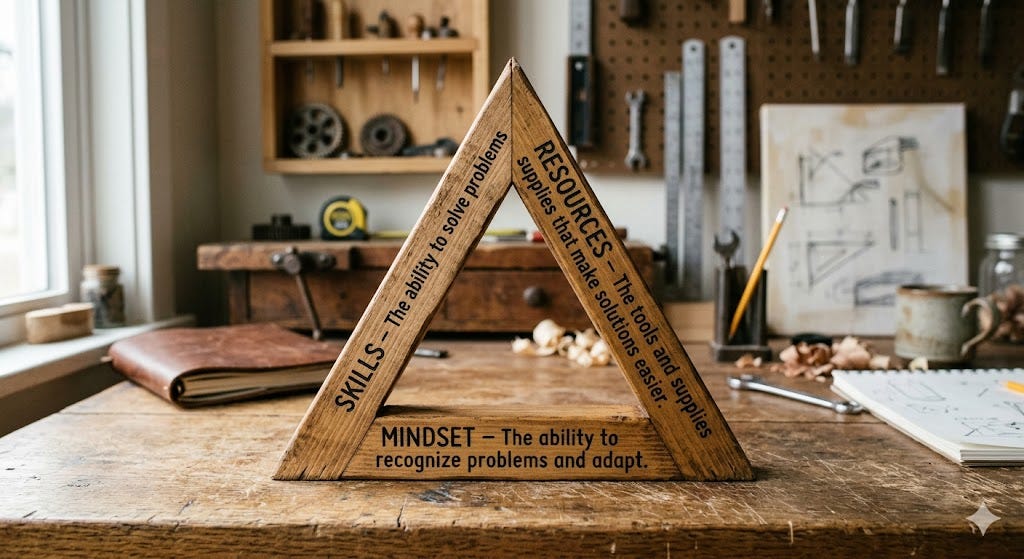
Preparedness can be thought of as a triangle with three sides:
Mindset – The ability to recognize problems and adapt.
Skills – The ability to solve problems.
Resources – The tools and supplies that make solutions easier.
A prepper mindset teaches you to anticipate challenges. A survivalist skill set enables you to overcome them. Resources support both.
Together they create resilience—the ability to absorb disruption, adapt to changing circumstances, and continue functioning when others are struggling. If and when SHTF, you will need resilience, courage and conviction to survive and to ultimately thrive.
If you get advance info on banking shutdowns let me know
Thank you